AI agents embedded in browsers are circumventing standard security controls, according to Darkreading. The gap leaves enterprise environments exposed as agentic deployments accelerate.
Fujitsu and Scaleway signed an MoU on November 27th to test CPU-based AI inference in European cloud infrastructure. The partnership combines Fujitsu's Arm-based MONAKA CPU with Scaleway's cloud platform to reduce power consumption and supply chain risk.
The contrast is capability vs. jurisdiction. GPU clusters are powerful but foreign-controlled. A validated CPU inference path on Scaleway gives European buyers a sovereign option they can actually procure.
French telecoms group iliad plans to invest €3 billion in AI, according to Datacentremagazine. The commitment positions iliad as a major European operator in AI infrastructure build-out.
Security researchers have identified flaws in MCP server implementations from Anthropic and Microsoft. The vulnerabilities highlight systemic security risks as AI agents gain access to live systems and data.
Scaleway, the cloud arm of French group Iliad, has acquired data platform Saagie. The deal aims to deliver a fully sovereign, integrated data and AI platform for European operators.
Scaleway is buying capability it could not rent credibly. The question is whether vertical integration becomes a distribution advantage or just a more expensive product catalog.
The European Commission selected Scaleway, Iliad's cloud unit, to build a sovereign public cloud and AI platform for EU institutions. The contract places a French operator at the center of European digital infrastructure.
Scaleway owns the plumbing; US hyperscalers are locked out. The signal is not the contract announcement. The signal is where EU public-sector distribution just moved.
Scaleway has purchased 1,000 Nvidia H100 GPUs and expanded its cloud services to 52 countries. The French operator is building owned GPU capacity while extending its distribution footprint.
Scaleway owns the hardware; most European rivals rent it. The question is whether 52 markets generate enough enterprise demand to justify the capital outlay.
Scaleway, the European cloud and AI platform owned by iliad Group, has launched a cloud region in Milan. The move marks the company's official entry into the Italian market.
Scaleway builds the plumbing in Italy. Whether Italian buyers choose a European operator over an established US hyperscaler determines if the investment converts to revenue.
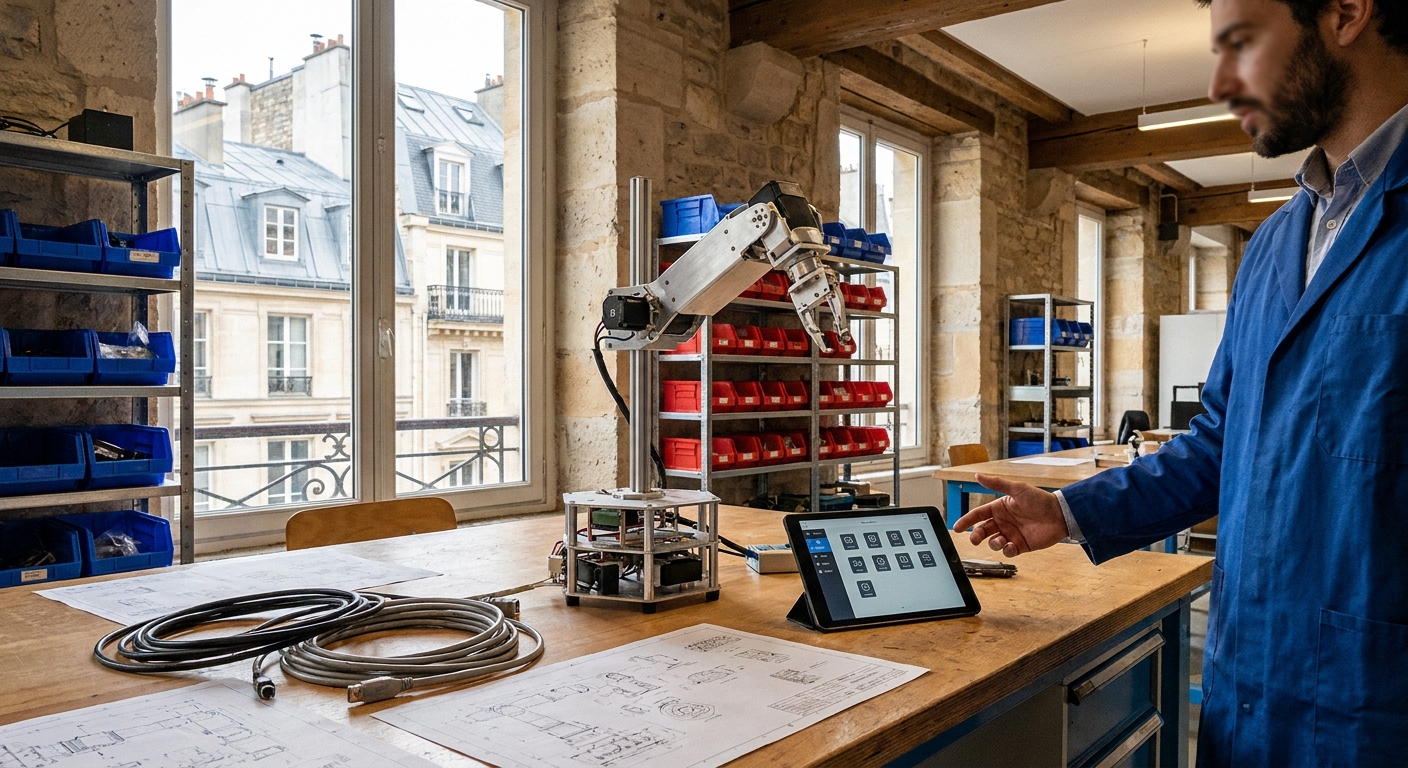
Hugging Face released an agentic toolkit for its Reachy Mini robot. Users describe behavior in plain English; the AI agent writes, tests, and ships the code. Around 10,000 units are deployed.
Capability shipped cheap is not the signal. The signal is whether plain-language control moves Reachy Mini from hobbyist shelf to classroom and lab, where France's open-source robotics ambitions actually land.
Hugging Face has launched an open-source app store for its Reachy Mini robot, offering over 200 apps. The move creates a distribution layer for robot software that did not previously exist.
Hugging Face, a French-founded lab, is moving from model host to platform owner. The signal is not the hardware. The signal is where software distribution just moved.
Acronis Threat Research Unit found active malware campaigns abusing Hugging Face and ClawHub. Attackers disguise payloads as models, datasets, and agent extensions to exploit developer trust.
Developers treat model repositories like trusted package managers. They are not. The operator who skips validation pays the cost the lab never guaranteed.
Mistral has closed $830 million in debt financing to build a data center near Paris powered by 13,800 Nvidia GB300 GPUs. The site, selected in 2025, will train Mistral models and deliver inference services at 44 MW capacity.
Mistral is trading rented clarity for owned infrastructure. The buyer is European sovereignty; the operator relieving that buyer is Mistral, not a US cloud provider.
Scaleway's chief executive argues the EU can still build a competitive cloud industry. The claim challenges the assumption that US hyperscalers have permanently locked in the market.
Too Good To Go deployed Mistral AI models on Amazon Bedrock to analyze why partner stores left its platform. The food-waste marketplace, with nearly 200,000 active stores, turned sales interaction data into actionable retention improvements.
Capability is not the story. Retention is. Mistral wins not by being the smartest model, but by becoming the tool an operator trusts to protect its supplier base.
French startup Generare has raised 20 million euros to address the shortage of novel molecular data in synthetic biology. Founded in 2023, it operates at the intersection of AI and biology.
Mistral AI has released Workflows in public preview, an orchestration layer built to run AI processes reliably in production. Enterprises including ASML, ABANCA, CMA-CGM, France Travail, and La Banque Postale are already using it.
Capability was never the gap. The gap was production reliability. Mistral now sells the plumbing and the palace, which makes displacement of point-solution orchestration vendors a real near-term watch.
Paris-based LightOn has closed a €30 million Series B round to expand its enterprise RAG platform. The company's technology helps large organizations deploy LLMs over proprietary document collections while maintaining data privacy. Key customers include BNP Paribas and Airbus. The round was led by Eurazeo with participation from Bpifrance, bringing total funding to €52 million.
LightOn's customer list — BNP Paribas, Airbus — shows enterprise RAG is moving from proof-of-concept to procurement. The Bpifrance co-investment pattern is becoming standard for French AI rounds.
French cloud provider Scaleway has deployed new NVIDIA H100 GPU clusters in its Paris data centers, targeting AI training and inference workloads. The expansion quadruples Scaleway's AI compute capacity and offers a European alternative to US hyperscalers for organizations with data sovereignty requirements. Pricing undercuts AWS and Azure by approximately 20% for comparable GPU configurations.
The 20% price undercut on sovereign infrastructure is a real value proposition — it turns GDPR from a compliance cost into a cost-saving opportunity. Watch whether Scaleway can maintain that margin as they scale.
Bpifrance has selected 12 AI-focused startups for its Deep Tech accelerator, providing combined funding of €45 million. The cohort includes companies working on medical imaging AI, industrial automation, and French-language NLP. Each startup receives up to €3.8 million in grants and equity investment, plus access to government compute credits through the national AI cloud initiative.
BPI's compute credits are the underrated part — access to GPUs is the real bottleneck for European startups. The €3.8M cap per company is enough for serious pre-seed/seed work but not enough to train frontier models.